Last Updated on May 29, 2026 by Masha Eretnova
Beach days are long. Once the initial excitement of sand and waves settles, kids start circling back — bored, wanting a snack, asking what’s next. This beach scavenger hunt fixes that problem fast.
It adds structure without taking over the day, and it works whether you’re at the ocean, a lake, or just leaning into a beach theme at home or in the classroom.
This free beach scavenger hunt printable includes three separate games, each built for a different age group and challenge level.
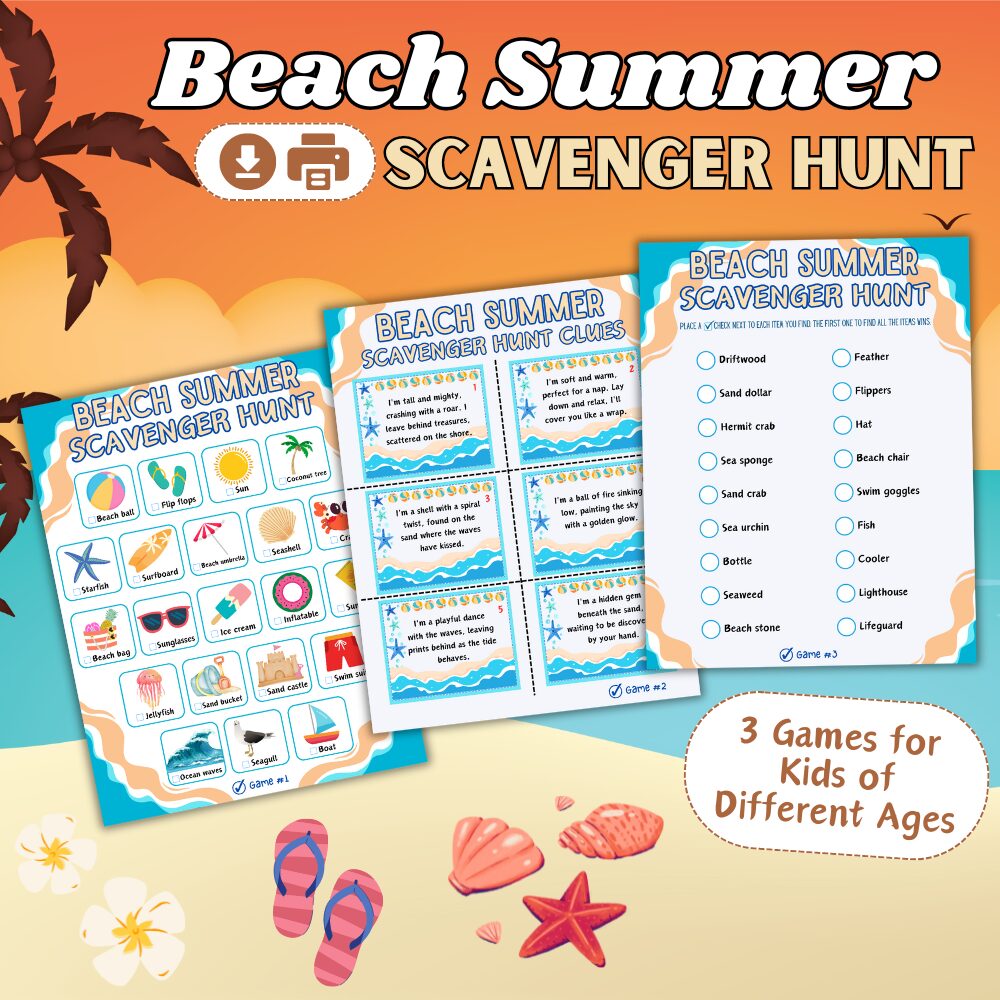
Grab the free PDF below — enter your email and it downloads instantly.
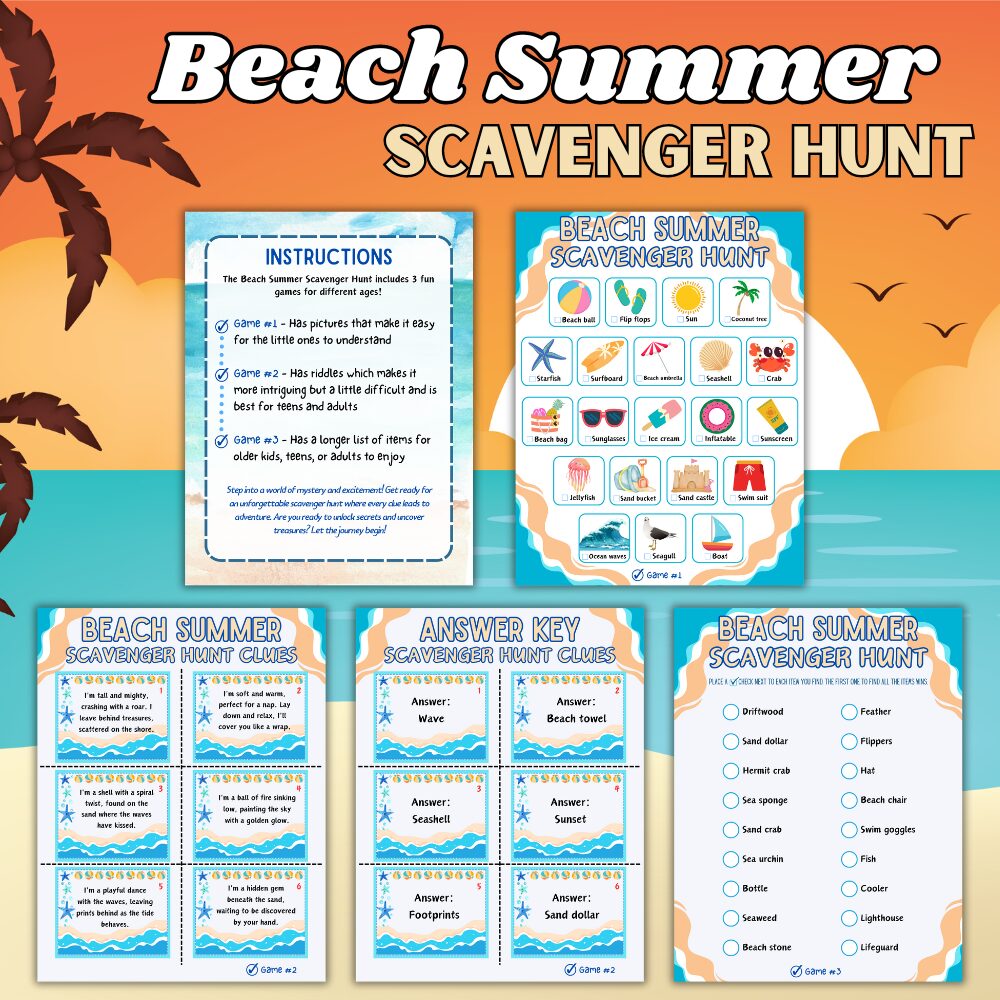
What’s Inside the Printable
The pack covers three distinct games, so the same printable works across a wide age range. Younger children aren’t stuck with a list they can’t read, and older kids aren’t bored with something too simple.
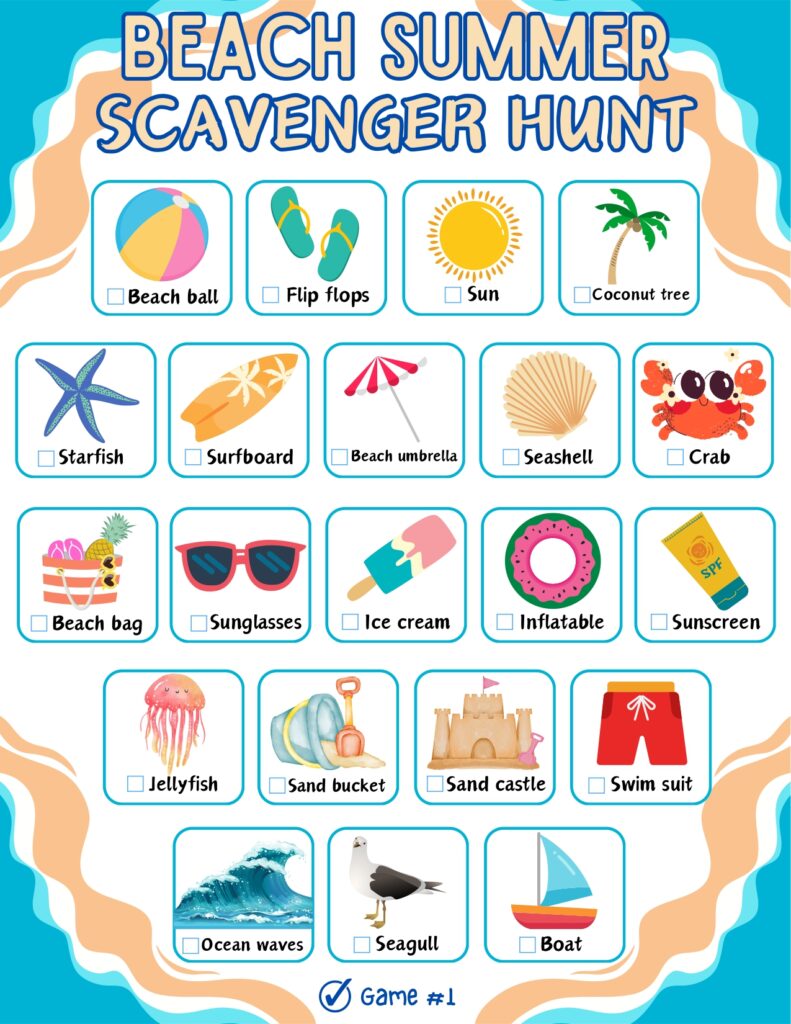
Game #1 runs on pictures.
Each item on the checklist shows a labeled illustration — a beach ball, flip flops, sunglasses, jellyfish, a sand castle, a seagull, and more. Toddlers and preschoolers who can’t read yet point and match without any help. There are 22 items total, covering everything from a coconut tree to a swim suit to ocean waves.
Game #2 switches to riddles.
Six clue cards each describe a beach find without naming it. One describes something tall and crashing that leaves treasures on the shore. Another describes something soft and warm that covers you like a wrap.
Players read the clue and hunt for the answer — wave, beach towel, seashell, sunset, footprints, sand dollar. An answer key is included on a separate sheet so the adult running the game doesn’t have to guess.
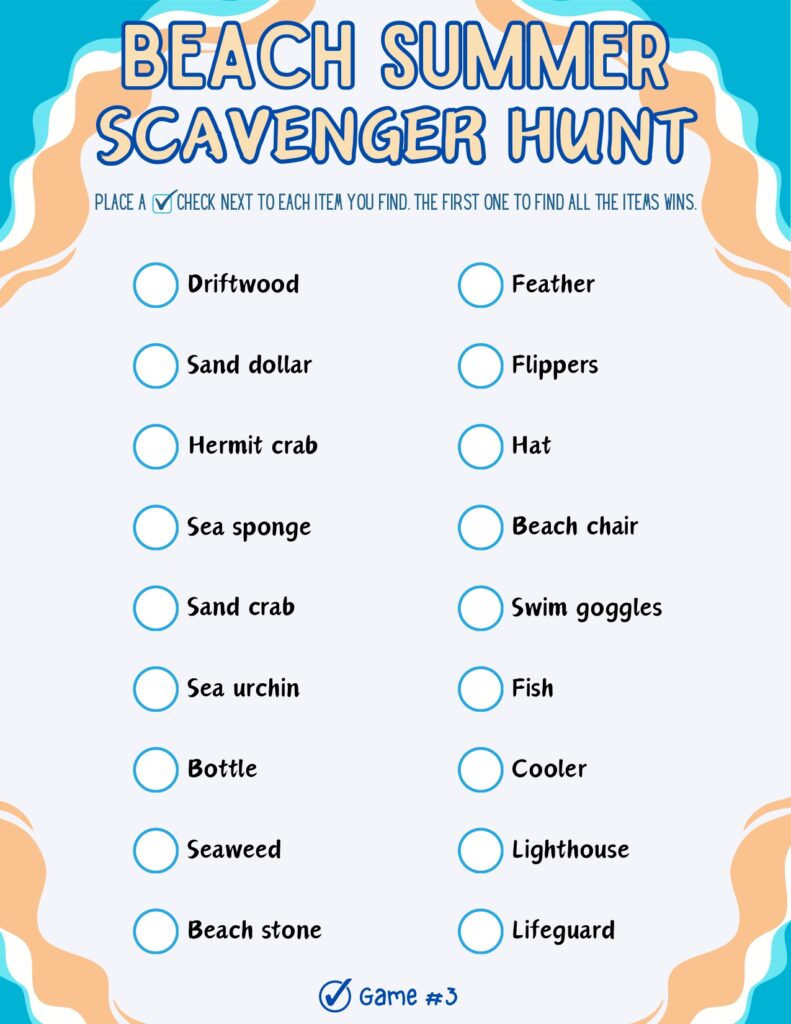
Game #3 is a straight checklist, but with a harder item list.
Driftwood, hermit crab, sea urchin, sea sponge, sand crab, seaweed, bottle, beach stone, flippers, swim goggles, cooler, lighthouse, lifeguard — 18 items that push players to look past the obvious and pay attention to what’s actually around them. First person to check off everything wins.
What Age Is This For?
Game #1 suits ages 2 to 6. The picture format means even children who don’t recognize written words can play independently.
Game #2 works from around age 8 upward. The riddles require some reading and a bit of lateral thinking, which makes it better suited to older children, teens, and adults.
Game #3 sits in the middle-to-older range — ages 6 and up can handle the checklist format, though the specific items on the list (sea urchin, driftwood, lifeguard) challenge even adults to look carefully.
For a mixed-age group, run all three at once. Younger children work through Game #1 while older siblings or parents tackle Game #2 or #3. Everyone plays, nobody waits around.
What You Need
- A printer,
- standard letter-size paper or cardstock,
- and something to write with for checking off items.
- optional, clipboard for each player is a nice addition if you have them.
Cardstock holds up better in beach conditions — regular paper wilts fast near water and sand.
How to Use the Beach Scavenger Hunt
Step 1: Download and Print
Enter your email below and the PDF arrives in your inbox. Print the pages that match the ages in your group. For younger children, print Game #1. For a mixed group, print all three and hand each player the version that fits. Print in color if possible — the Game #1 illustrations are much easier to read in color.
Step 2: Decide on the Rules
The simplest format is a race — first player to check off every item wins. For a cooperative version with younger children, work through the list as a group and check things off together. For Game #2, you can cut the clue cards apart and hand them out one at a time, or give all six at once and let players tackle them in any order.
Step 3: Head Out and Hunt
For a real beach setting, start at one end and work along the shoreline. Remind players to look up as well as down — a seagull, a boat, and ocean waves all require looking outward, not just scanning the sand at your feet. For Game #3 items like a lighthouse or a lifeguard station, scanning the surroundings from one spot often works better than walking in one direction.
Step 4: Check In on Game #2 Answers
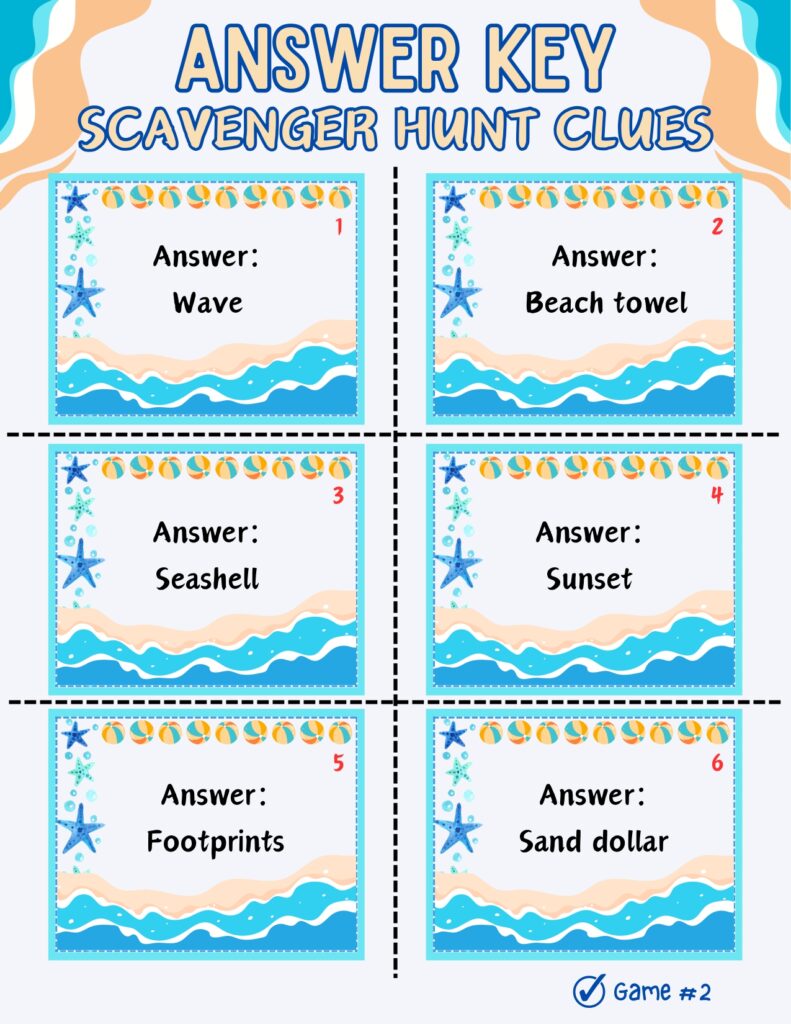
If you’re running Game #2, hold the answer key until players think they’ve found all six. Then go through the answers together. It works well as a group moment rather than a solo reveal — players often argue good-naturedly about whether footprints in the tideline count or whether the wave they saw was close enough.
Step 5: Declare a Winner (or Don’t)
For competitive play, the first player to complete their list wins. For a more relaxed day, skip the competition entirely and just use the list as a guided way to explore. Both approaches work depending on the group.
Tips for Getting the Most Out of It
Laminate the sheets before heading to the beach if you plan to reuse them across multiple trips. A dry-erase marker for checking off items means the same sheet works every time.
For a classroom or daycare activity, pair Game #1 with a short discussion about ocean animals beforehand. Pull up photos of a jellyfish, a starfish, and a hermit crab before the hunt so children know what to look for. It works as a simple nature lesson without needing any extra planning.
Game #2 also works well as a rainy-day or at-home activity. Read the riddles aloud and see if children can guess the answers without going to an actual beach. The riddles stand on their own as a quiet thinking game.
FAQ
Do I need to be at a beach to use this? Game #1 and Game #2 work anywhere with a beach theme — a backyard, a classroom, or at home after a beach trip. Game #3 is most effective at an actual beach or lakeside since several items (driftwood, sea urchin, hermit crab) are harder to find away from the water.
Can I use this for a birthday party? Yes. Split guests into teams and run all three games simultaneously as a relay — complete Game #1, then move to Game #2, then Game #3. First team through all three wins.
What if my child can’t read yet? Game #1 uses pictures throughout, so reading isn’t necessary. Point to each picture together and let children do the spotting.
Is the answer key included? Yes. The answer key for Game #2’s riddles is a separate page in the PDF so the adult in charge can check answers without giving anything away.
How long does it take to complete? Game #1 runs about 15 to 20 minutes at a real beach. Game #2 depends on how quickly players find the answers — anywhere from 10 minutes to the better part of an afternoon. Game #3 is open-ended; some items like a sea urchin take real patience to find.
Is this really free? Yes. Enter your email below and the full PDF downloads immediately — all three games plus the answer key, ready to print.
Masha Eretnova, born in 1991, is a Chiang Mai-based certified teacher, artist, and blogger with 20+ years of personal painting journey.
She started painting and drawing very early and is now an international abstract artist and educator passionate about acrylic painting, gouache, and crafts.
Her works are part of international exhibitions and contests, including ArtlyMix (Brazil), Al-Tiba 9 (Spain), Exhibizone (Canada), Italy, and many more.
Besides her artistic pursuits, Masha holds a post-grad diploma in Teaching Film Photography and 2 music school diplomas: piano and opera singing.